Dinner for Two and Nobody's Complaining
How an empty kitchen, a good playlist, and a bottle of wine turned cooking from a chore into my favorite part of the day
Dinner for Two and Nobody's Complaining
I didn't grow up in a family of great cooks. Go ahead, call my mom, she’ll back me up!

A happy woman in the kitchen (women who want to belong in the kitchen, belong in the kitchen. Women who don’t, don’t!)
Vegetables came from a can. Frozen if we were lucky. My parents owned a bakery, so there were nights when dinner was donuts. The perks were real. The nutritional balance was, at best, debatable.
But somewhere along the way, probably while watching a chef on television make something with fresh herbs, butter, and actual intention, I thought: I want to eat like that.
So, I taught myself to cook. One recipe at a time. One disaster at a time, honestly. Burned garlic. Over-salted sauces. The first chicken leg I ever fried squirted out a stream of blood when I sliced into it.
For years, cooking was tangled up with feeding. Feeding kids who suddenly didn't like mushrooms after loving them last week. Feeding a household that wanted tacos when I'd already started pasta. Feeding people on a schedule, on a ticking timeline, on fumes. I loved my family around that table. But some nights, the kitchen felt less like a creative act and more like a shift I couldn't clock out of.
Then the nest emptied.
And the kitchen became mine.
Here's what nobody tells you about cooking after the kids leave: it gets better. Not because the food improves…but of course it does, because you're no longer negotiating with a teenager who considers ketchup a food group; but because the whole feeling of it changes.
It stops being a task. It becomes a ritual.
Most evenings now look something like this: I pour a glass of wine. I put on a playlist (lately it's been one called Diane Keaton Cooking in a Turtleneck, which is exactly as perfect as it sounds.) The kitchen fills up with music and garlic and whatever I'm experimenting with that week. Mercy sits nearby, or stands at the counter with her own glass, and we talk about our days. Not in the rushed, logistical way we used to — who's picking up the kids, did you call the dentist, we're out of milk — but in the slow, unhurried way of two people who finally have time to listen.
Then we sit down. We eat something I made with my own hands. We linger.
That's it. That's the whole evening. And it's one of my favorite things in the world.
The cooking itself has changed too. When you're no longer feeding a crowd or working around five different preferences, you can get curious. You can spend a Sunday afternoon making ravioli from scratch just to see if you can. You can try the recipe that intimidates you. You can use the fancy cheese. Ah, lawd help me, how I love a fancy cheese!
Lately our kitchen has been all over the map. One night it's crispy pork schnitzel with a warm herb potato salad, you know, the kind of meal that feels like a hug from a German grandmother I never had. The next it's gochujang chicken thighs with kimchi fried rice, because Mercy will happily eat whatever I put in front of her, and that kind of trust makes you brave in the kitchen.
Last week I made a vegetarian tom kha soup with tofu, coconut milk, lemongrass, lime, the sort of thing that fills the whole apartment with a smell you want to bottle. The week before that, homemade ravioli with roasted garlic and farmer cheese, which took twice as long as it should have and was worth every minute.
Every recipe teaches me something. Patience, usually. Timing. When to stop fussing and let the heat do its work. How much salt is actually enough. That the best meals aren't the most complicated ones; they're the ones you made slowly, with good music playing and someone you love nearby.
I still don't call myself a chef. I'm not sure I ever will.
But I am someone who got curious, kept practicing, and discovered, at an age when some people assume you've already learned everything you're going to learn, that the kitchen is one of the best classrooms I've ever walked into.
Cooking didn't just teach me to make better food. It taught me to slow down. To treat a Tuesday night like it deserves a nice bottle of wine and a cloth napkin. To stop saving the good stuff for company.
An empty nest doesn't leave you with less to do. It gives you room to discover what you actually love, and then to do it slowly, with the music up and the phone somewhere you can't hear it.
What did you teach yourself after the kids left? I'd love to hear.
This week's recipe — the one I keep coming back to:
Crispy Chicken with Charred Cabbage, Roasted Carrots & Preserved Lemon Mostarda
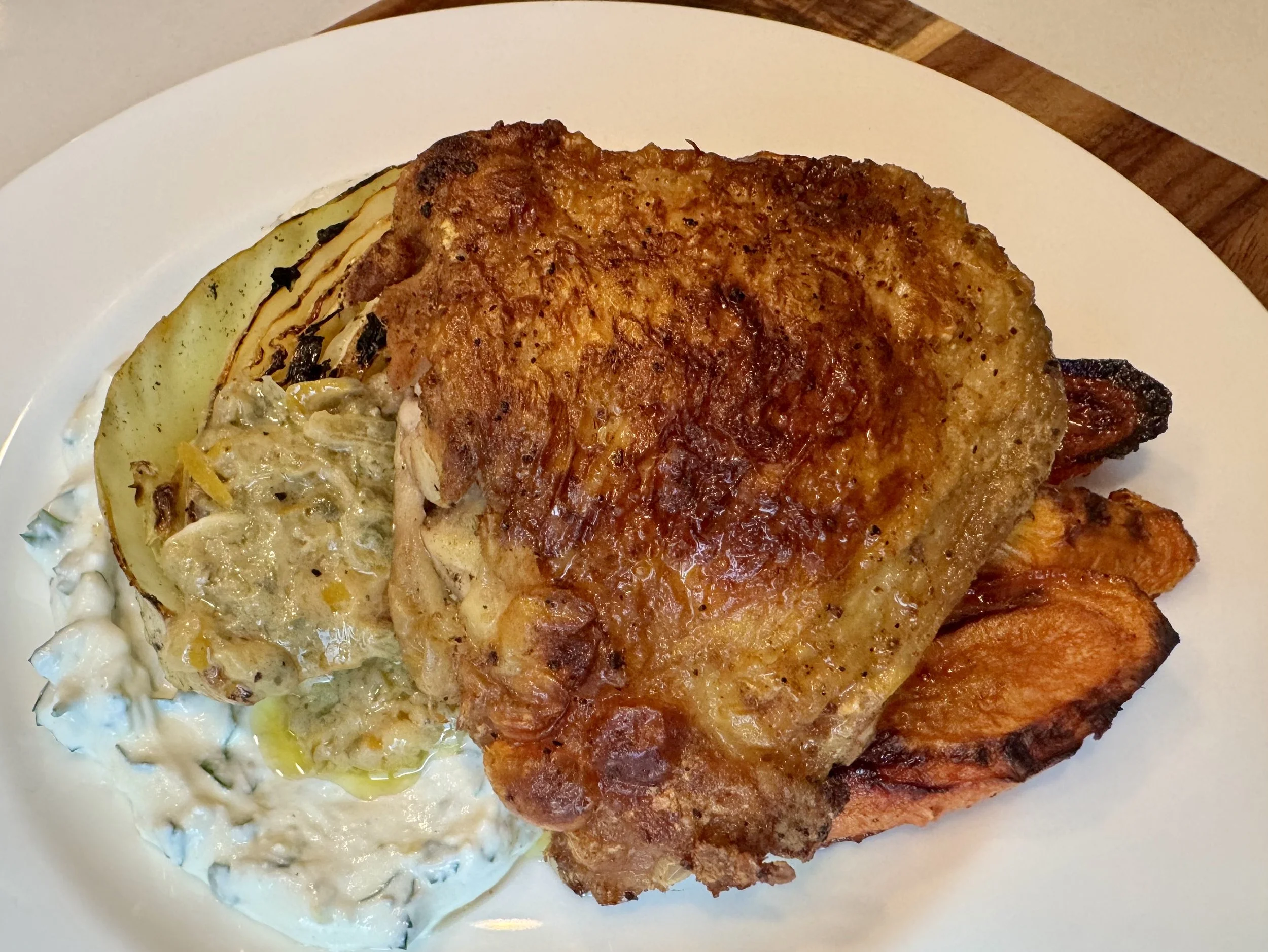
Crispy Chicken with Charred Cabbage, Roasted Carrots & Preserved Lemon Mostarda
Serves 2
Crispy Chicken
4 bone-in, skin-on chicken thighs · 1 tsp kosher salt · ½ tsp black pepper
Pat the thighs dry with paper towels; this is what gets you crispy skin. Season generously on both sides. Heat a cast iron skillet over medium-high. Place the chicken skin-side down and don't touch it. Let it render and crisp for 8–10 minutes until the skin is deeply golden. Flip, sear 2 minutes, then transfer to a parchment-lined sheet pan and finish in a 400°F oven for 15–18 minutes. Pour off most of the fat but leave a couple of tablespoons in the pan for the cabbage.
Roasted Carrots
4 carrots, peeled and halved lengthwise · 2 tbsp olive oil · salt · 1 tsp honey
Toss with oil and salt. Roast at 425°F until tender and caramelized, about 25–30 minutes. Drizzle with honey in the last few minutes.
Charred Cabbage
1 small green cabbage, cut into wedges (keep the core intact so they hold together) · reserved chicken fat
Sear the wedges in the reserved chicken fat over medium-high heat until nicely charred, about 3–4 minutes per side. Add a splash of water, cover briefly to soften, then uncover and let the liquid cook off until the cabbage is tender and coated in the fat. This is the quiet star of the plate. Don't skip it.
Preserved Lemon Mostarda
2 tbsp preserved lemon, finely chopped · 1 tbsp Dijon mustard · 1 tbsp olive oil · pinch of sugar · 1 tsp capers, roughly chopped (optional) · salt and pepper
Stir together and adjust to taste. It should be bright and punchy.
Savory Yogurt
½ cup Greek yogurt · 1 garlic clove, finely grated · 1 tbsp lemon juice · 1 tbsp fresh parsley, finely chopped · salt and pepper
Stir together and season to taste.
To serve: spread the yogurt across the bottom of a plate. Arrange the chicken, cabbage, and carrots on top. Spoon the mostarda over everything. Pour the wine. Put the phone away.
This essay is part of the Become series on Empty Nest Rebellion.
Want essays like this in your inbox? Subscribe to the newsletter — it's free.